Hair Straightening vs Rebonding: Product, Heat Control and the Finished Result
Both straighten the hair, so what differs? Product strength, heat control, treating sections separately, and how natural the result looks.
This is the most common question in consultations. The underlying principle really is the same — product softens the bonds inside the hair, a heat tool reshapes it, and a second step locks the new shape in. But the same three stages, carried out differently, produce very different results.
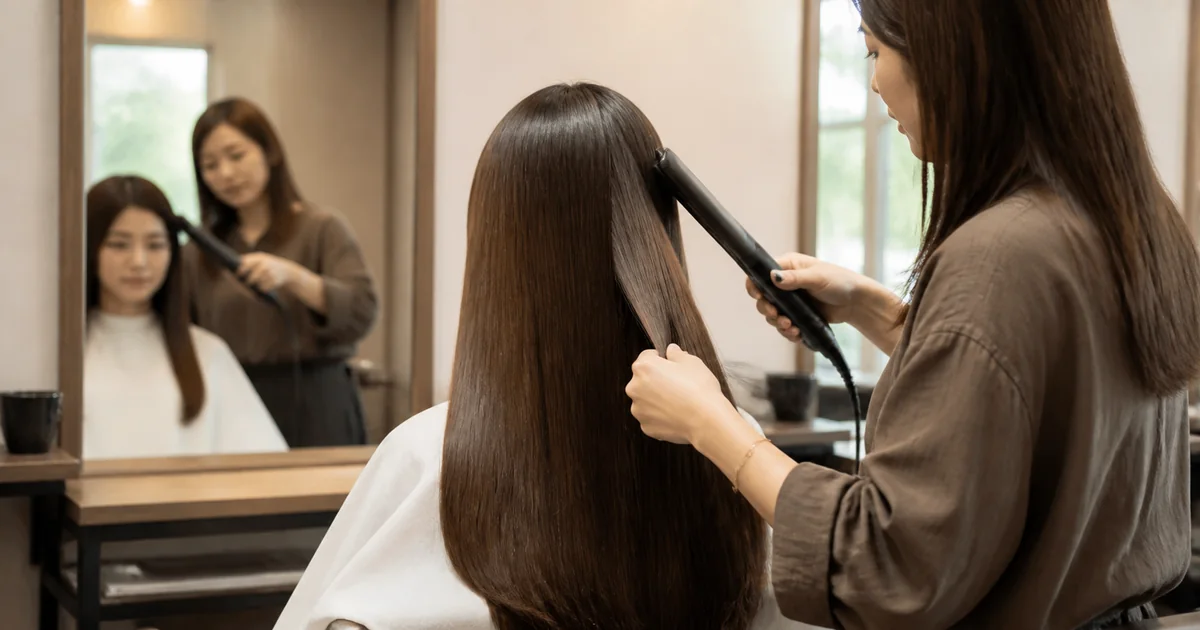
Same principle, different execution
Rebonding is the simpler approach: one product across the whole head, one temperature, worked through from top to bottom. The goal is straight.
Hair straightening in the Japanese sense is about treating sections separately. On any one head, the roots, mid-lengths and ends are usually in very different condition — the roots are healthy new growth, the ends may have been coloured three times. Using one product at one temperature across all of it leaves the healthy parts under-treated and pushes the damaged parts too far.
So the process starts by assessing the condition of each section, then mixing product strength and processing time separately, with the iron temperature adjusted to match. It takes longer, and almost all of the extra time goes here.
The result: straight, or smooth
This is the most visible difference.
Rebonding easily produces a flat, pressed look — very straight, but also lacking dimension, reading almost as if the hair is stuck to the head. As it grows, the bend in the new growth against the poker-straight treated length creates an obvious step.
Japanese-style straightening aims for smooth rather than straight. It keeps a little natural bend and movement, the ends do not stick out stiffly, and the hair feels softer. The join as it grows out is less obvious, precisely because it was never taken to zero curve.
If your goal is truly no bend at all, rebonding is closer to that. If what you want is hair that looks natural and is easy to handle each day, the straightening approach fits better.
They tolerate damage differently
In practice this matters more than the finish.
Chemical softening plus high heat is a double load. If the hair has been bleached, coloured many times, or is already breaking, treating the whole head at a fixed temperature carries clearly more risk — the damaged sections cannot take it, and you get breakage or ends with a scorched, brittle feel.
Section-by-section assessment exists to address exactly this: lower product strength and temperature where the hair is compromised, full strength only where it is healthy. That does not mean any condition can be treated — it means the workable range is wider.
Situations where waiting is better: recent bleaching, visibly poor elasticity, a wound or inflammation on the scalp, or not long since the last treatment. The Banqiao natural curl guide covers these in more detail.
One thing both share: it does not reverse
Either way, the section that has been straightened will not go back to curly. That is not a flaw — it is what the process does. Once the bonds are reformed, that is the new shape.
Two consequences. First, be sure of the direction before starting, because the only way out is growing it and cutting it off. Second, never treat the same section twice. Touch-ups go on new growth only; overlapping is the most common cause of breakage.
Working out which suits you
Three questions to ask yourself:
- Do you want completely straight, or natural and smooth? This sets the direction.
- What has your hair had done in the last two years? More bleaching and colouring makes section-by-section treatment more necessary.
- How long will you spend on it daily? Both reduce styling time, but the smoother version still needs basic drying.
Elasticity, damage and scalp condition are confirmed in person before the approach is decided. To discuss it beforehand, send photos of your hair air-dried — front, side and back — through Faye's LINE.
For the smooth long-hair direction specifically, see Korean-style smooth long hair for natural curls.
The suitable approach and achievable result depend on an in-person assessment of your hair.