Korean-Style Smooth Long Hair for Natural Curls: From Frizz to an Easy Daily Routine
Natural curls going frizzy, puffy or uneven? Hair assessment, styling direction and daily care to know about before going for smooth long hair.
Naturally curly hair does not have to end up with no movement at all. For a lot of people the better goal is to cut down the frizz and the uneven volume while keeping the way the hair falls, so that long hair looks smooth and glossy and is easier to handle yourself each morning.
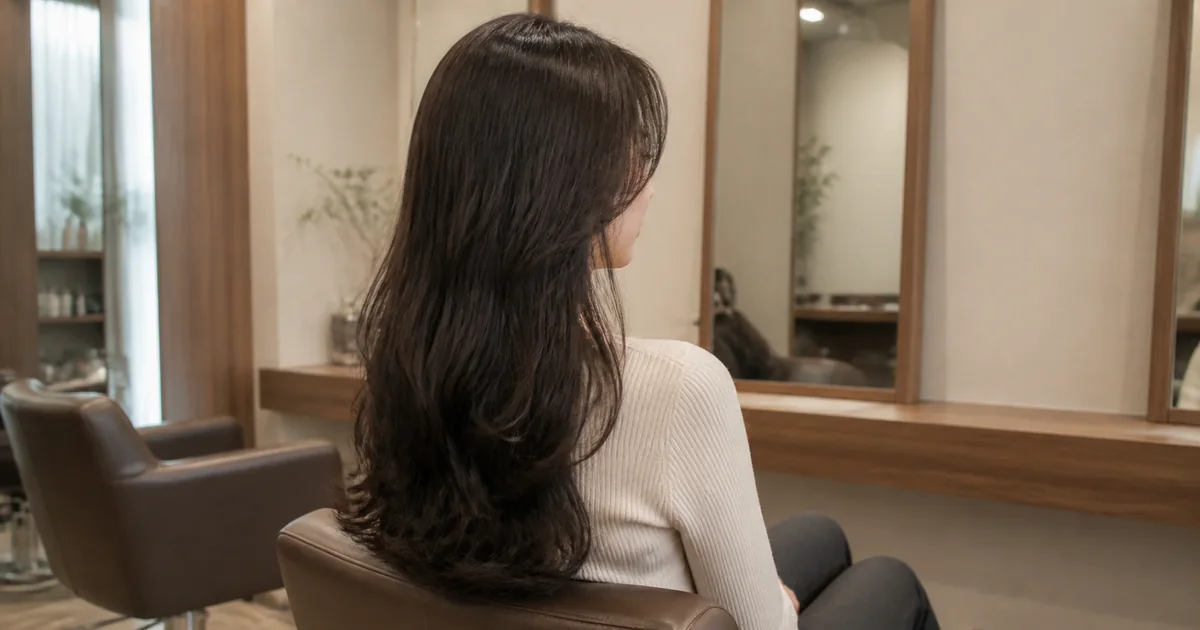
Why curls tend to look frizzy and puffy
Curl pattern varies along a single strand. When the hair is short on moisture, unevenly damaged, or dried in a way that does not suit it, a few things tend to show up:
- Dry ends, with the curl breaking into pieces that are hard to bring together.
- Volume through the roots and mid-lengths, so the overall shape reads as untidy.
- Everything swelling the moment it gets humid, undoing whatever you did that morning.
None of this points to one single fix. Your hair condition, colour and perm history, how much curl you want to keep, and how many minutes you can realistically give it each day all change what suits you. If you are not sure where your curl sits on the scale, the Banqiao natural curl guide has a simple way to place yourself.
It is not just about straightening the hair
Getting soft, manageable long hair out of curls is mostly a question of proportion: roots that are not flattened, mid-lengths without irregular swelling, and ends that still keep some natural bend and movement.
That is the main difference from going completely poker straight. Take out every trace of curve and long hair easily reads as flat and shapeless, and the step where new growth comes in becomes far more obvious. Keeping a little natural bend actually makes the shape look lighter, and it grows out better.
During a consultation Faye starts with your hair and your daily habits before talking about direction. Some people mainly need less frizz, some are worried about dry ends, some want to keep the natural bend but tidy the outline. The aim is not to apply a fixed template — it is that you can keep it looking comfortable and natural once you are home.
Length and layering decide how easy it is to live with
The same hair, cut differently, can be a completely different amount of work each morning.
Curly hair has its own spring to it. Layer it too high and the mid-lengths puff out; layer it too little and the ends sit heavy and lose their movement. As a rule, leaving enough length around the face to shape the outline while keeping the weight relatively concentrated further back makes a smooth line easier to hold.
Length around the shoulders deserves particular attention. When hair lands right at the shoulder line, the ends get pushed up and flick out, and curl exaggerates that. If you would rather not fight your ends every day, ask your stylist to avoid that length, or leave it longer so the weight pulls it down.
Three places to start with daily care
1. Blot the water out first, then dry in sections
Press gently with a towel rather than scrubbing. When drying, deal with the roots first, then follow the way the hair falls down to the ends — that alone cuts down flicking and volume. Working in sections costs a few extra minutes but it is much faster than drying everything at random and then trying to fix it.
2. Keep product on the ends light and even
Use whatever treatment suits your hair, but start with a small amount and concentrate it on the drier mid-lengths and ends. Too much and the hair loses body, and the roots start to look flat or greasy.
3. Watch the trimming rhythm
Once the ends of long hair go dry and split, the whole line starts reading as frizzy. Regular trims and a check on condition make everything else easier.
Getting through the humid months
In Banqiao the rainy season and summer afternoons regularly undo by lunchtime whatever you did at eight in the morning. That is not a technical failure — it is what hair does when it takes on moisture from the air.
What you can do is reduce how far it moves. Make sure the roots and the under layers are genuinely dry before you leave, because the parts that were still damp are the first to swell. Put a small amount of moisture or styling product on the ends so the surface picks up less humidity. And avoid running your hands through it repeatedly on a humid day.
If several months of every year are simply a lost cause, that is a reasonable point to look at hair straightening. Because it changes the structure of the hair, it holds up against humidity far more consistently than a routine alone can.
Who this direction suits, and who it does not
It tends to suit: moderate curl, frizz and uneven volume as the main complaint, wanting to keep the length and some natural movement, and a few minutes a day for drying.
It needs more discussion if: your hair has been bleached recently or shows visible breakage, you want zero curve at all, or you would rather spend no time on it. None of those rule it out — they just mean setting expectations first, or the gap afterwards will be jarring.
Start with an assessment
Everyone's hair and priorities are different, and so are the results that are actually achievable. If you are thinking about making your curls easier to live with, it is worth talking through your current condition, the length you want and the look you are after, and planning from there. There are more articles in the hair straightening category.
To book a consultation or ask about services, message Faye's LINE.
Conceptual representation of hairstyle; actual results vary depending on individual hair condition.